

Packaging tube labelling tube sticker cosmetics low MOQ
Tube sticker pasting: professional tubes from 100 pieces, in Pakistan
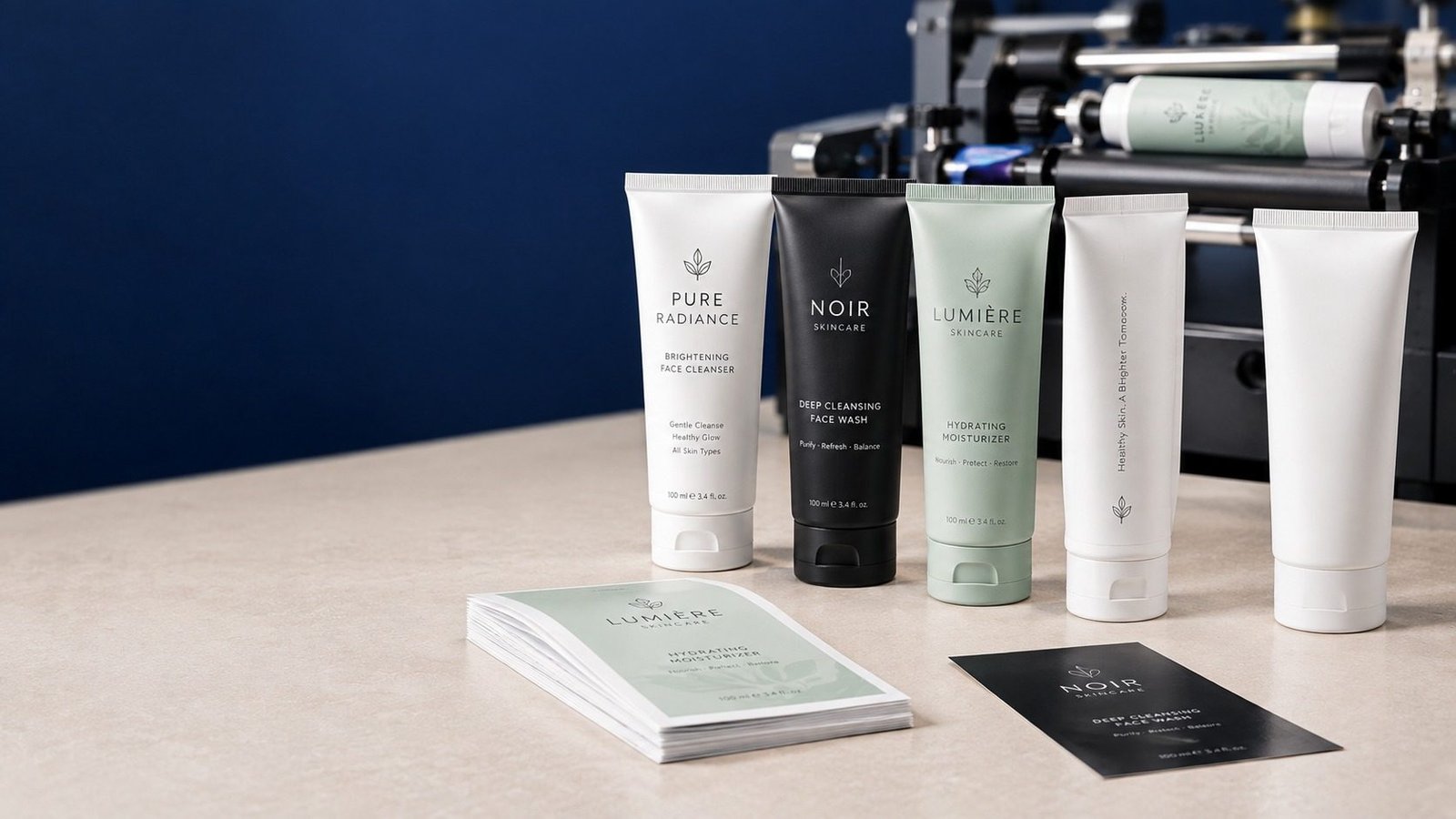
Tube sticker pasting is how a small brand gets a tube that looks factory-printed without ordering thousands of them. The label is printed and laminated, die-cut to the tube, and applied by machine so it sits straight and flat with the seam on the back — and it starts at 100 tubes. We can supply the blank tubes too, so one order arrives ready to fill. Here is why the printed-tube route locks new brands out, what makes a sticker look printed rather than stuck on, who is using it, and exactly how an order runs from a sample to a delivery.
The problem: printed tubes start in the thousands
A squeeze tube is made by extruding or laminating the sleeve, printing it flat or on a mandrel, then heading and capping it. The printing step is set up per artwork, and a tube factory recovers that set-up over the run — which is why most will not quote a new design below a few thousand pieces, and why the price per tube at a few hundred, if they quote at all, is unrecognisable next to the price at ten thousand.
That is fine for an established brand reordering a product it already sells. It is a wall for everyone else: a skincare line launching its first moisturiser, a clinic starting a private-label range, a food producer moving a sauce into a tube, or a brand that wants to test a new variant before committing. They face a choice between a stock tube with a hand-stuck label that looks exactly like that, or money tied up in tubes for a product that has not sold yet. Most choose the first and their product looks cheaper than it is.
What tube sticker pasting actually is
The service replaces the factory print with a label — but a label built for a tube and applied like a factory would apply it. The artwork is printed on film, laminated, and die-cut to a dieline drawn for that tube’s diameter and taper. It is then applied by machine, either as a full wrap that meets itself at the back or as front-and-back panels, on blank tubes we supply or on tubes you send us.
The result is a tube that reads as printed. At arm’s length there is nothing to give it away; up close, a full wrap has a hairline seam at the back — where a laminate tube from a factory carries its own side seam. We would rather say that plainly than claim it is impossible to tell, because the honest version is the one that survives your first sample. Our tube sticker pasting page lists what we apply and the finishes available; as far as we know, it is the first time this has been offered in Pakistan as a ready package — label, application and tube — at a quantity a new brand can afford.
Why a good one looks printed and a bad one looks stuck on
Four decisions separate the two, and a hand-applied paper label gets all four wrong at once.
Material. A tube is squeezed every day. Paper creases on the first squeeze and never recovers; film flexes with the tube and returns flat. The label has to be a film.
Adhesive. Most tubes are polyethylene or a plastic laminate, which are low-energy surfaces that ordinary adhesives release from at the edge. The adhesive is chosen for the tube material, so the edge stays down for the life of the product, through a humid bathroom and an oily hand.
Lamination. The product itself is the enemy. Creams, oils and sunscreen actives attack print. A matte, gloss or soft-touch lamination seals the ink under a clear film that wipes clean and does not scuff in a handbag.
Application. This is the one people underestimate. A label applied by hand is a degree or two off, has a bubble somewhere, and overlaps unevenly at the seam. A label applied on a roller applicator is square to the tube every time, pressed on without air, with the seam placed at the back to the millimetre. The machine is why a hundred tubes look like the same tube.
Who it is for
Cosmetics first, because cosmetics live in tubes: face wash, moisturiser, sunscreen, hand cream, hair masks, serums, lip products. Our cosmetics packaging page covers the carton and rigid box that usually go with the tube, and most clients end up ordering the labelled tube and the printed mono carton together, so the outer and the inner arrive matching.
Then small-batch food: honey, sauces, pastes and spreads moving from a jar to a squeeze tube. Then clinics, dermatologists and salons launching a private label, where the run is a few hundred a month and the presentation has to match the price of the consultation. And then established brands — for a limited edition, a seasonal variant, a gift set, or a market test that should not disturb the main tube order. Pharmaceutical ointment and gel tubes can be labelled the same way; they are printed to the artwork you approve, and regulatory responsibility rests with the marketing authorisation holder.
How an order runs: tube, artwork, sample, run
The tube. Tell us the size, fill volume and cap — flip-top, screw, nozzle — or tell us the product and we will recommend one. If you already have tubes, send one and we label to it. If you do not, we source blank tubes with the order, so there is one supplier and one delivery. That is the “all in one, ready in one go” part: you are not buying tubes from one place, labels from another and sticking them on yourself at the kitchen table.
The artwork. Send it, or send a brief and our designers build it. Either way it goes onto a dieline drawn for that tube, not a generic rectangle. The ends of a full wrap meet at the back, so nothing critical sits within a few millimetres of either end, and a continuous pattern is designed so the join does not cut through it. The usual rules — bleed, safety margin, outlined fonts, CMYK — are in our artwork guidelines and we check every file at preflight.
The sample. Before the run we print and laminate the label, apply it to a blank tube, and put that tube in your hands. Not a PDF, not a render — the physical thing, so you judge the fit, the colour and the finish on the real surface. This is the sampling stage of every job we do, and on tubes it matters more than usual because the curve changes how colour and type read.
The run. Then we produce the quantity — 100, 300, 2,000 — and deliver tubes ready to fill. Reorders use the same dieline and the same proof, so the second hundred matches the first.
Sticker versus printed tube: which one, when
The two are not rivals so much as two ends of a quantity line. A label has no plate and no factory set-up, so its price per tube is nearly flat: a hundred cost roughly a hundred times one. A printed tube has a large set-up and a small per-piece cost, so it is expensive at low quantities and cheap at high ones. Below the crossover, the label wins on price and — because it involves no minimum — on whether you can order at all. Above it, the printed tube wins on price and has no seam. The same economics decide between digital and offset for cartons, and our digital printing page explains that side.
Where the crossover sits depends on the tube size, the label size and finish, and what the tube factory is quoting that month, so we do not publish a figure. What we do is quote both when your quantity is anywhere near it and tell you which to buy, even when it is the smaller invoice for us. A brand that starts on labels and moves to printed tubes at volume has lost nothing; a brand that waits for volume before it has a product on a shelf has lost the months.
What it costs, and what decides it
Five things. The quantity. The label size — a full wrap uses more material than a front panel. The material and lamination. Any foil, metallic or spot-UV finish. And whether we are supplying the tubes. Because there is no plate, the price does not fall steeply with quantity; the second hundred costs about what the first did, which is exactly what makes a first order of 100 sensible. Everything else on the invoice — the carton, the box, the leaflet — is priced the way custom packaging is priced generally, and we are happy to quote the whole presentation together.
Start with one sample tube
Send the tube size or the product, the quantity you have in mind and your artwork through the quote form, or call or WhatsApp 0327 2777728. We confirm the label spec, send a labelled sample tube, and quote the run — from 100 pieces, with or without the tubes. The first thing you receive is a tube you can hold, and if it does not look printed to you, we have not earned the order.
Tell us the tube and the quantity. A labelled sample comes first; the run starts at 100.


