

Materials stickers labels vinyl transparent stickers
Paper, vinyl, clear, silver or holographic: choosing a sticker material
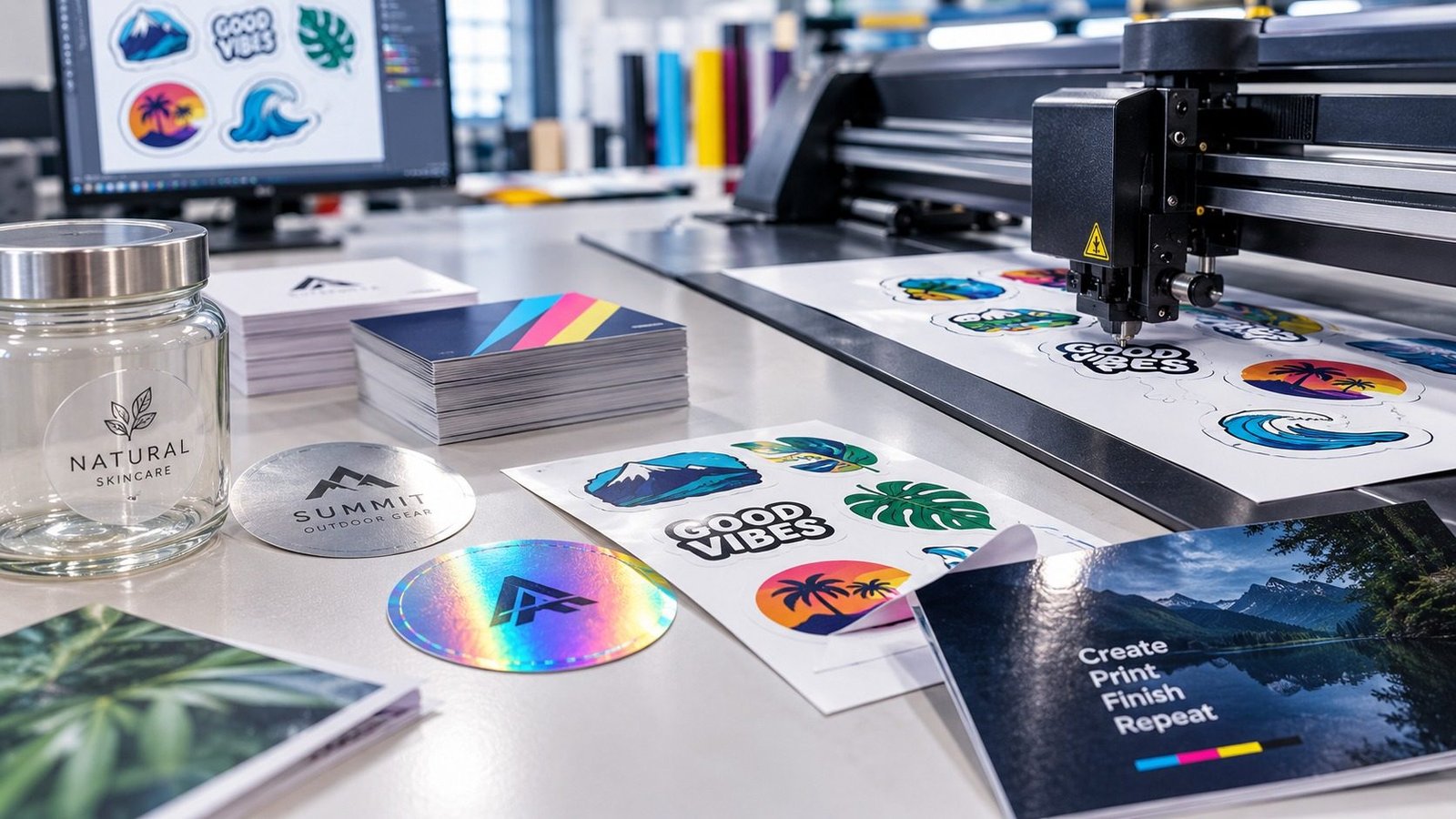
The right sticker material is decided by three things: where the sticker will live, what it sticks to, and how it should look. Paper is the economical choice for dry, indoor, short-life jobs. Vinyl is the default for anything that meets water, oil, sunlight or a squeeze. Clear film makes the design look printed straight onto the product. Silver and holographic films add a metallic or rainbow surface, for a premium look or a tamper-evident seal. Below is how each one behaves, where each one fails, and the questions that settle the choice before you pay for a run.
Start with where the sticker will live
Most sticker failures are not printing failures. The print was fine; the material was wrong for the place it ended up. So before the design, answer three questions.
What will it meet? A dry shelf is easy. A bathroom, a kitchen, a fridge door, a delivery van in July and a gym bottle that goes through a dishwasher are not. Water, oil, condensation, heat and sunlight each rule materials out.
What will it stick to? Cardboard, glass, a PET bottle, a polyethylene tube, painted metal and a laptop lid are different surfaces, and some plastics are hard for ordinary adhesive to hold. A curved or squeezable surface also needs a material that flexes rather than creases.
How long must it last? An event sticker needs a week. A product label needs the shelf life of the product. An asset tag needs years. The answer decides how much protection is worth paying for.
Paper: for dry, indoor, short-life jobs
Paper stickers print crisply, take any design, and cost the least, which is why they carry so much everyday work: carton seals, shipping and address labels, price stickers, giveaway sheets and labels for dry goods in a jar.
Paper’s limit is water. It absorbs moisture, so a damp hand smudges the edge, condensation lifts it, and a squeeze leaves a permanent crease. A gloss or matte lamination makes the face wipe-clean, but the cut edge is still paper and can still wick water in. If the sticker will be near water more than occasionally, it should be film.
An uncoated paper has one advantage no film shares: you can write on it with an ordinary pen. That makes it the sensible choice for labels a person fills in by hand.
Vinyl: the default when it has to survive
Vinyl (PVC) is a flexible plastic film. Water does not soak into it, it does not tear easily, and it bends with a curved bottle or a squeezed tube and returns flat. For most product labels and most stickers that will be handled, it is the right starting point.
Vinyl comes in indoor and outdoor grades, and the difference matters. Sunlight fades unprotected ink and weathers the film, so a sticker for a car, a shop window or a meter box needs an outdoor film and a laminate over the print. How long it lasts outside depends on the film, the direction it faces and the climate, so we tell you what the specific material is rated for rather than promise a number.
Ask about the adhesive at the same time. A sticker that must never come off and a sticker that must peel off cleanly next year are different products, and the surface — glass, painted metal, low-energy plastic — narrows the choice further. We confirm the adhesive against your surface when we quote. If the surface is a squeeze tube, our tube sticker pasting service handles the film, the adhesive and the machine application together.
Clear film: the no-label look
A clear sticker is printed on transparent film, so the product shows through everywhere the design does not. On glass, a clear PET bottle or a jar, the result reads as if the design were printed on the container itself — which is why clear labels are popular for cosmetics, drinks and anything whose contents are part of the appeal.
Clear film changes how colour works. Printing inks are translucent, so on transparent film every colour mixes with whatever is behind it. Bright colours over a dark liquid go muddy, and light text over a dark product disappears entirely. The cure is a white layer printed under the parts that must stay opaque. Whether your design needs one, and where, is the first thing to settle with a clear label; we confirm it for your artwork when we quote.
Clear film is also unforgiving in application. An air bubble that would be invisible under a white label shows plainly under a clear one, so clear labels going onto bottles or tubes in any quantity should be applied by machine, not by hand.
Silver film: metal without the foil
Silver sticker film has a metallic face. Ink printed over it becomes a tinted metal, and any area left unprinted stays bright silver, so a design can carry metallic accents across its whole surface without a separate process. It suits electronics, premium cosmetics, product seals, and asset and serial labels where a durable, technical look is wanted.
Silver film is not the same as foil. Hot foil stamping presses a metal layer onto chosen areas of an ordinary label with a heated die, and gives a sharper mirror finish on fine lines and logos. Silver film gives metal everywhere, with the design printed over it. If the metal is a small accent, foil is usually the better fit; if the label is meant to read as metal, the film is.
Holographic film: rainbow, and sometimes security
Holographic film breaks light into a shifting rainbow that changes as the sticker moves. Used decoratively, it is a quick way to make packaging, merchandise and giveaway stickers look special, and it photographs well — useful for anything that will end up on social media.
It is also used on seals and authenticity labels, and here it helps to be clear about what it does. A stock holographic pattern is available to anyone, so on its own it signals “premium”, not “genuine”. A security label earns the name from what happens when someone tries to remove or copy it — a material that tears or leaves a visible pattern when peeled, or a unique number on each label. If the job is protection rather than decoration, tell us what you are protecting against, and we will specify the label around that rather than around the shine.
Lamination, cutting and rolls versus sheets
Lamination is a clear film over the print. It protects against scuffs, moisture and cleaning, and it sets the look: gloss deepens colour, matte calms reflections and reads as understated. Our guide to matte or gloss lamination covers the choice in detail. On paper it is often essential; on vinyl it is what makes an outdoor sticker last.
Cutting decides the shape. A die-cut sticker is cut right through to its own shape; a kiss-cut leaves the backing whole so several stickers peel from one sheet. Short runs in any outline can be contour-cut on a plotter cutter straight from your artwork, with no die to pay for — the outline is part of the file.
Rolls or sheets depends on who applies them. Labels going onto products by machine, or by hand in large numbers, come on rolls. Stickers handed out, sold or applied a few at a time come on sheets. Our sticker and label printing page lists both formats and the shapes we cut.
A quick way to choose
| If the sticker… | Start with |
|---|---|
| Stays dry, indoors, and has a short life | Paper, laminated if it will be handled |
| Will be written on by hand | Uncoated paper |
| Meets water, oil, a fridge or a squeeze | Vinyl |
| Goes outdoors or in a window | Outdoor vinyl with a laminate |
| Should let the product show through | Clear film, with white under the opaque parts |
| Should read as metal | Silver film — or foil, if the metal is a small accent |
| Should catch the eye on camera | Holographic film |
| Must show if it has been tampered with | A security material, specified for the risk |
Where two rows apply, the harsher environment wins. A holographic sticker that will live outdoors needs the outdoor protection first and the shine second.
Hold one before you order a thousand
Materials are easy to describe and hard to judge from a description. The same design looks different on paper, vinyl, clear and silver, and a clear label in particular changes with the product behind it. So the sampling stage applies to stickers as it does to every job: a physical sample on the real material, on the real product where we can, before the run.
To quote, we need five things: where the sticker will live, what it sticks to, the size and shape, the quantity, and the artwork or a brief. Send them through the quote form, or call or WhatsApp 0327 2777728. If you are not sure which material fits, say so — choosing it is part of the quote, and it costs less to change a material before the run than to reprint after it. Files should follow our artwork guidelines, with the cut line on its own layer.
Tell us where the sticker will live and what it sticks to. We recommend the material and send a sample first.


